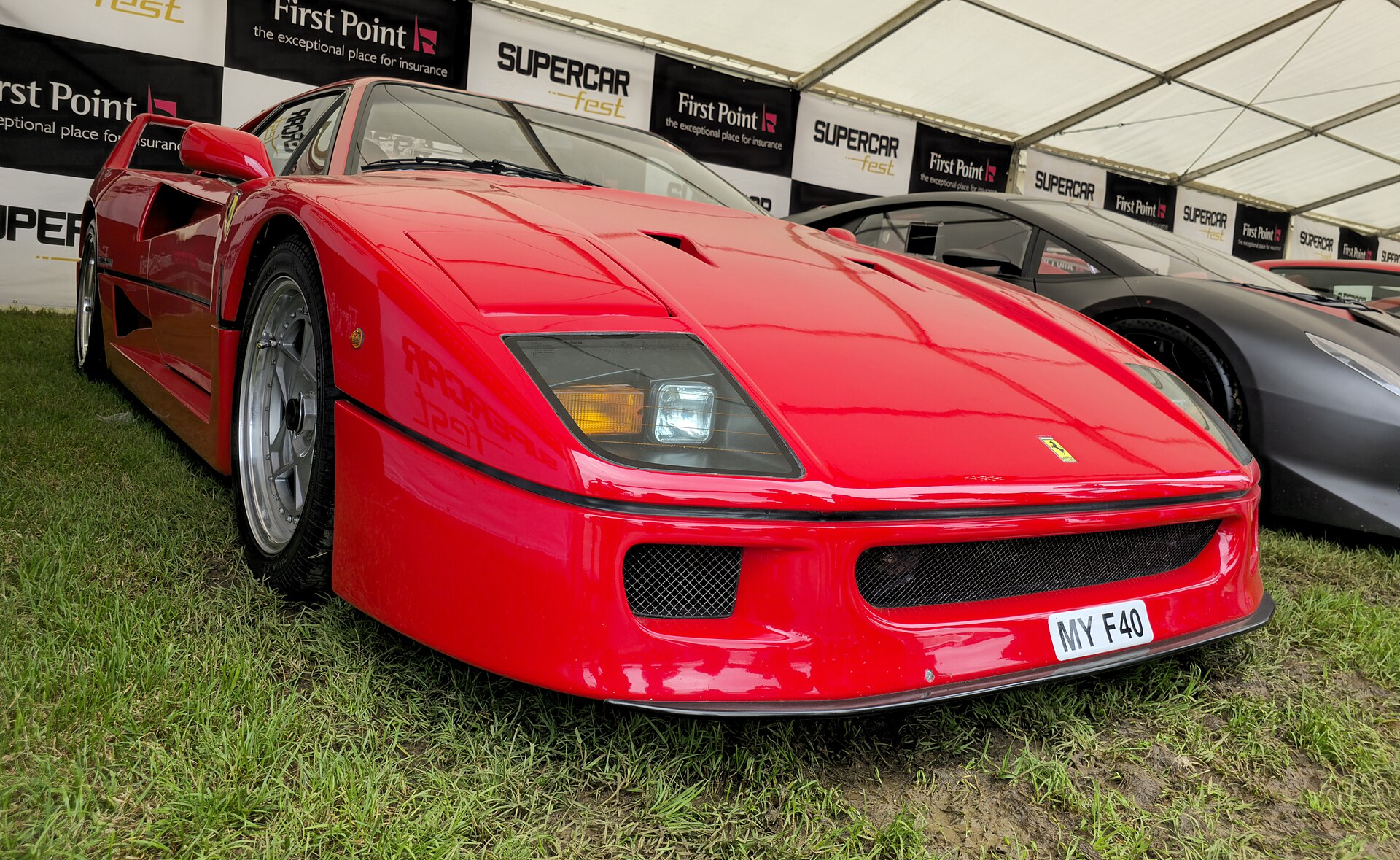
Enzo Ferrari's last personally approved car, and still the benchmark analog supercar.
The Ferrari F40 was built to celebrate the company's 40th anniversary, and it was the last Ferrari personally approved by Enzo Ferrari. It descended from the 288 GTO Evoluzione, a Group B race-car program left without a series when the FIA ended that category for 1986. Engineer Nicola Materazzi's small team adapted it for the road. Pietro Camardella penned the body under Aldo Brovarone at Pininfarina. Development began on June 10, 1986, and Enzo asked for the car to be finished in about eleven months, in time for a summer 1987 debut.
What made it special
The F40 was deliberately spartan. Ferrari's marketing department said at the time that customers had complained its cars "were becoming too plush and comfortable," and that the F40 was "for the most enthusiastic of our owners who want nothing but sheer performance." It was not meant as a high-tech showcase like Porsche's 959. When it went on sale it was Ferrari's fastest, most powerful and most expensive car, priced at roughly US$400,000, about five times the 288 GTO.
Key specs
Engine: 2,936 cc twin-turbocharged, intercooled 90° V8, enlarged from the 288 GTO's
Output (factory): 478 PS (471 hp) at 7,000 rpm and 577 N·m (426 lb-ft) at 4,000 rpm
Layout: mid-engine, rear-wheel drive
Production: about 1,311–1,315 cars, 213 of them for the U.S. Race versions (LM, Competizione, GTE) continued into the mid-1990s.
Collector values and news
F40 prices have climbed sharply. In January 2026, at Mecum Kissimmee, a 458-mile 1992 F40 from the late Phil Bachman's collection sold for $6.6 million, the most ever paid at auction for a standard F40. His second F40 followed at $5.83 million. In August 2026, RM Sotheby's Monterey sold a 320-mile 1991 U.S.-spec F40, delivered new to auto executive Lee Iacocca, for $8,365,000. For context, RM Sotheby's lists six F40s that sold for more than $2 million in 2025, led by a 1993 F40 LM by Michelotto at $11 million.
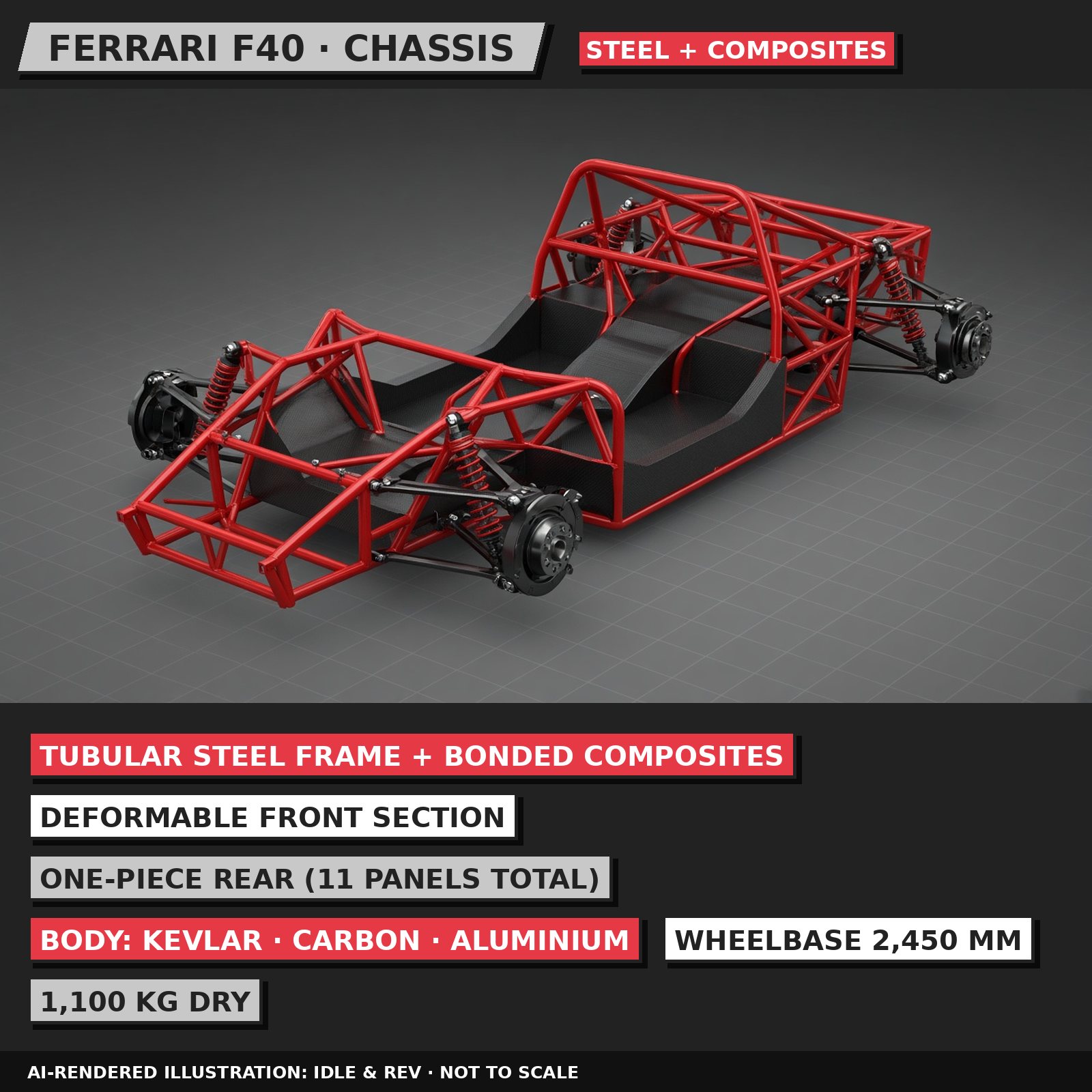
Tubular steel frame with composite elements bonded on with a special adhesive; extra stiffening braces vs. the 288 GTO
Progressively deformable front section
Body: Kevlar, carbon fibre and aluminium; just 11 panels thanks to large one-piece front and rear sections
2,450 mm wheelbase; 1,100 kg dry (Ferrari figure)
Bonding composites to a steel frame let the F40 stay light and stiff without a full carbon tub. The huge removable rear section gives access to all the mechanicals, a race-car approach to servicing.
Illustration: Idle & Rev (AI-rendered, for illustration; not to scale)
Suspension
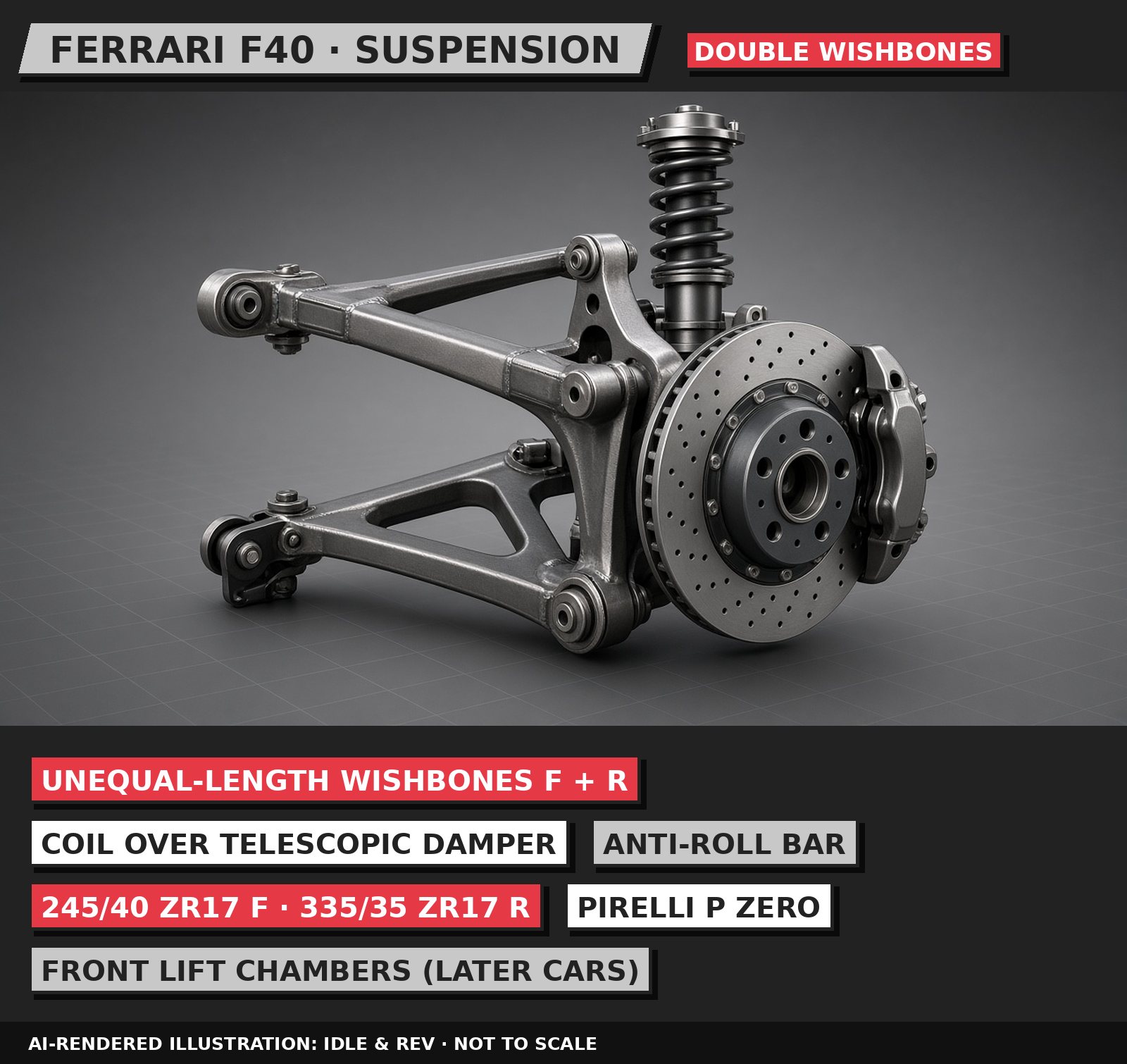
Front and rear: independent, unequal-length wishbones, coil springs over telescopic dampers, anti-roll bars
Based on the 288 GTO's double-wishbone layout with upgraded parts; later cars could raise ride height via hydraulic lift chambers in the front dampers
Tires: 245/40 ZR17 front, 335/35 ZR17 rear (Pirelli P Zero developed for the F40)
Double wishbones at all four corners is pure racing practice: precise camber control and plenty of feedback. There are no electronic aids, so the chassis and the driver do everything.
Illustration: Idle & Rev (AI-rendered, for illustration; not to scale)
Engine / Powertrain
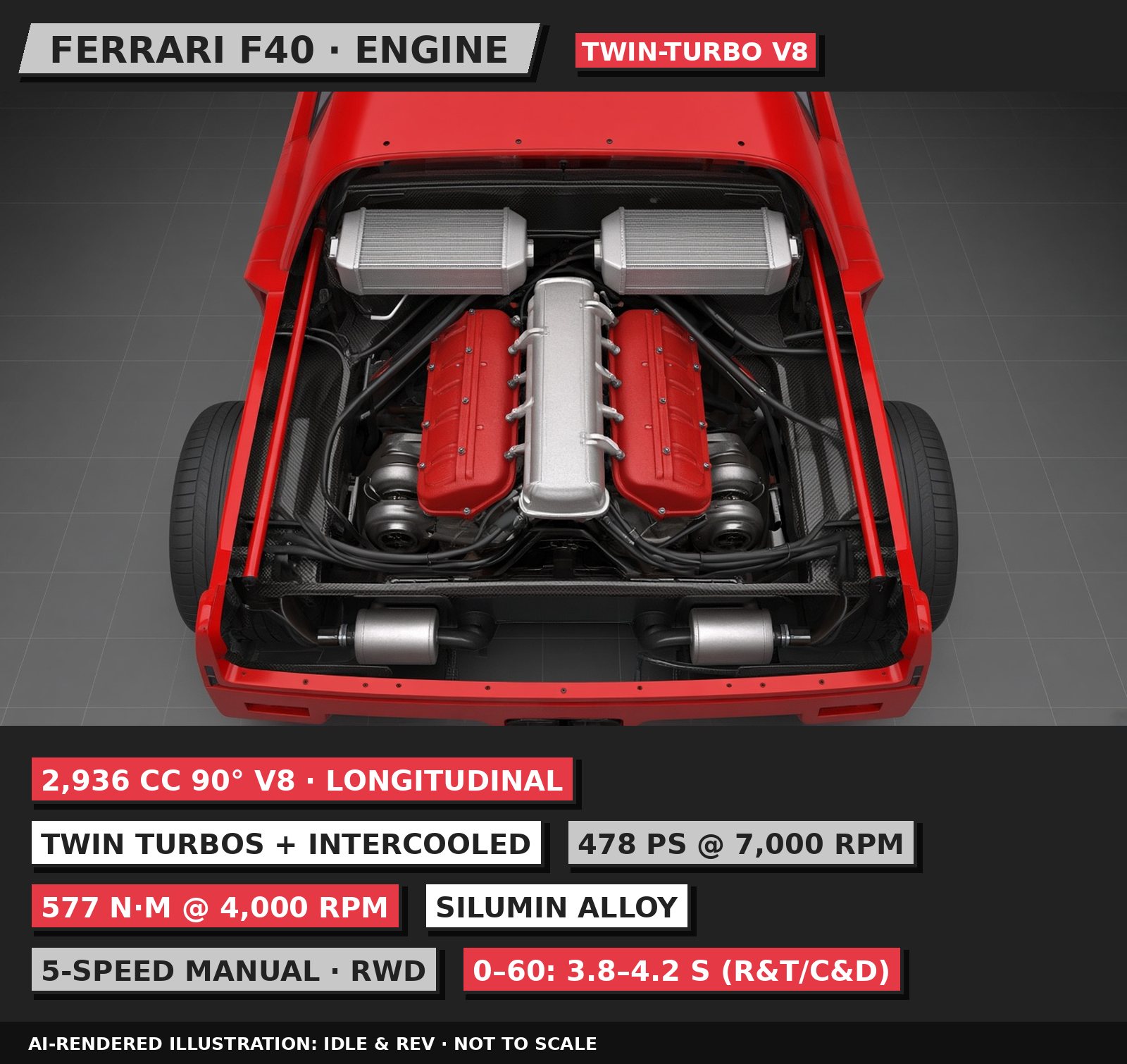
0–60 mph: 4.2 s (Car and Driver, 1991 U.S.-spec, Feb 1991 test); 3.8 s (Road & Track, Oct 1991 test). Ferrari's own figure: 0–100 km/h (62 mph) in 4.1 s
2,936 cc 90° V8, twin-turbocharged and intercooled, mounted longitudinally
478 PS (471 hp) at 7,000 rpm; 577 N·m (426 lb-ft) at 4,000 rpm (factory)
Block, heads, cam covers and intake manifolds cast in Silumin alloy; billet steel crank
5-speed manual, rear-wheel drive; Ferrari's last turbo engine until the 2014 California T
Early turbos meant lag, then a violent surge, and that all-or-nothing delivery is the F40's legend. With no driver aids, it rewards precision and punishes clumsiness.
Illustration: Idle & Rev (AI-rendered, for illustration; not to scale)
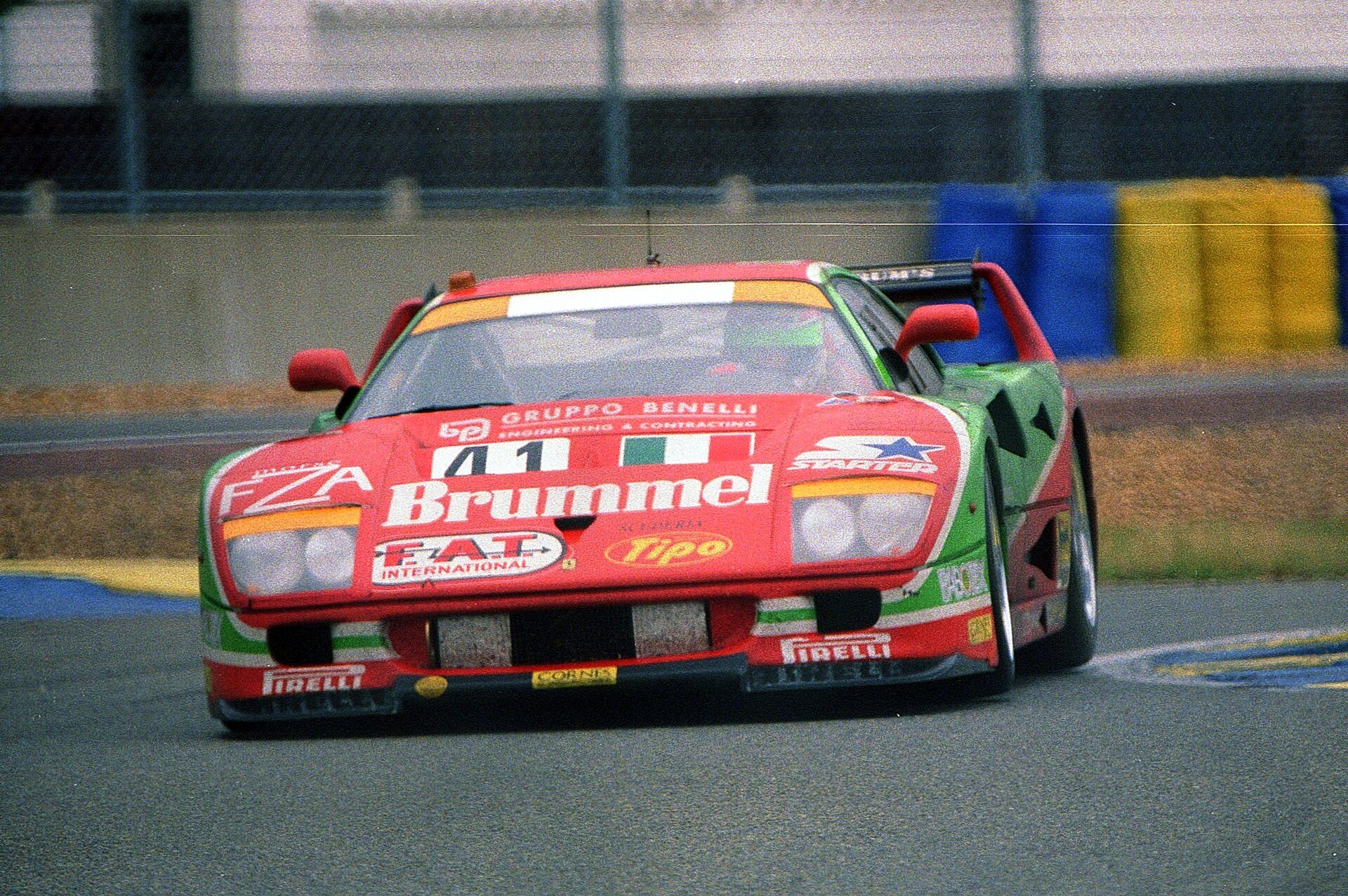
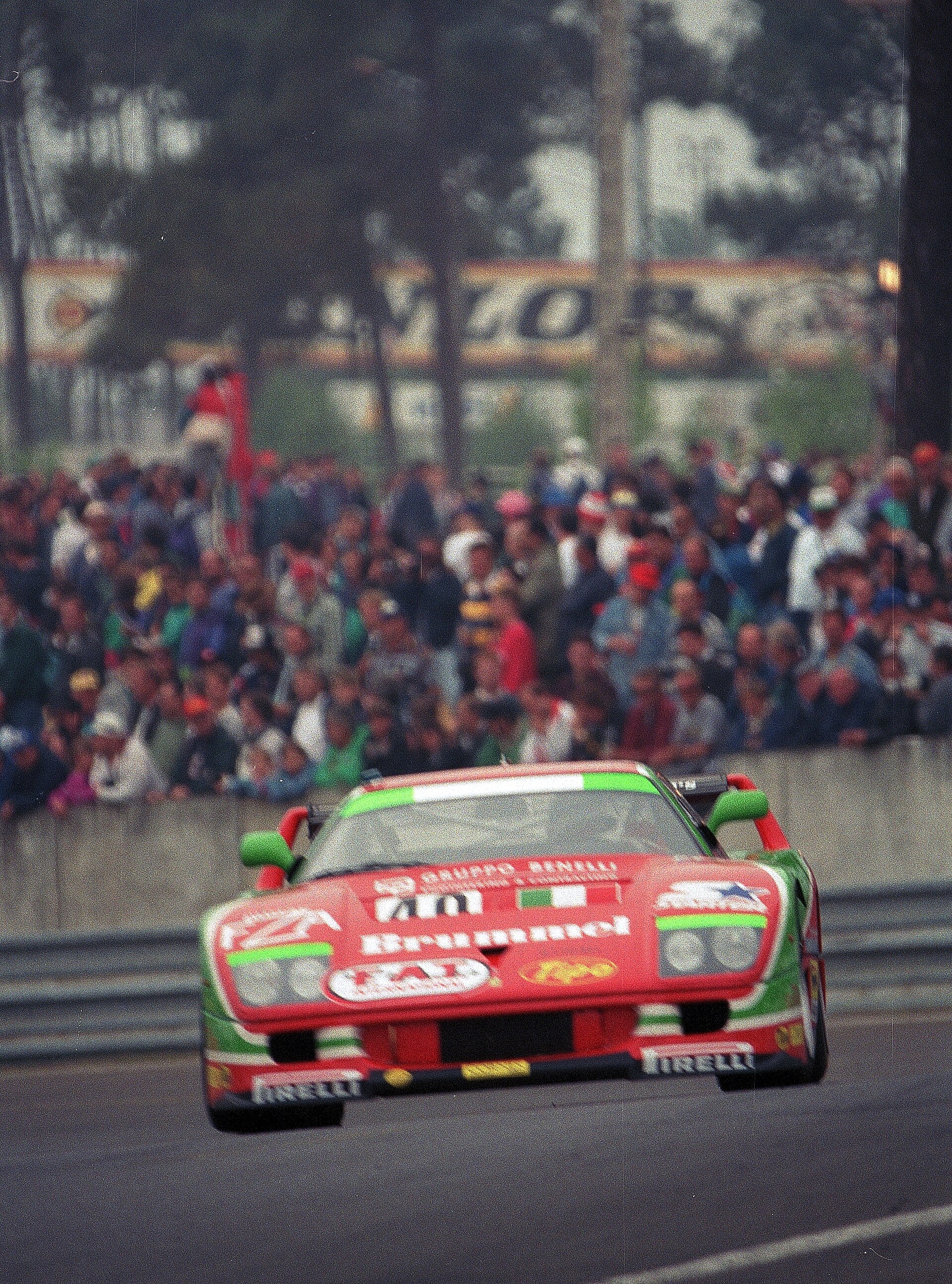
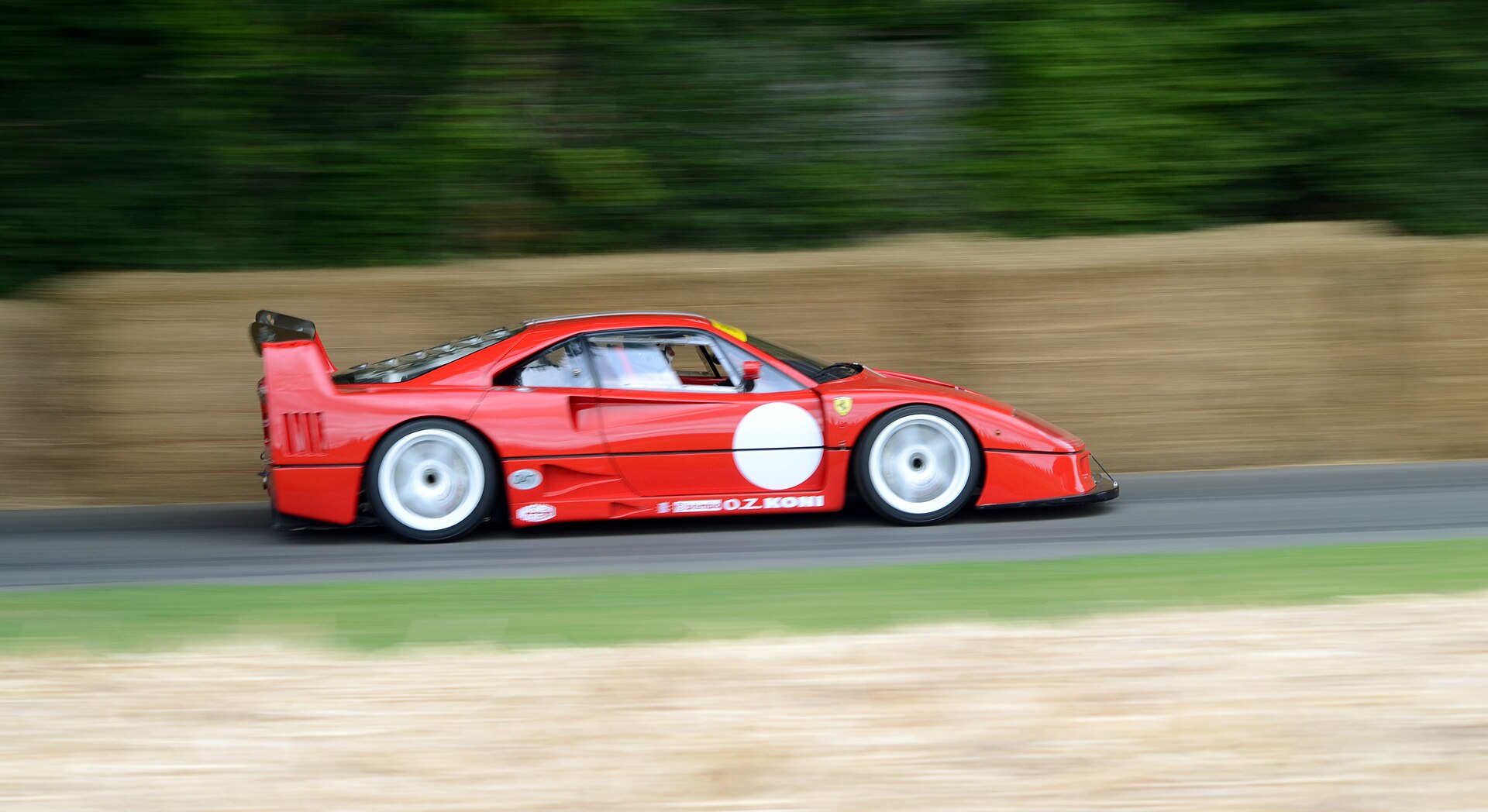
Michelotto prepared the F40 LM racers, and the car debuted at the IMSA round at Laguna Seca on Oct 15, 1989, where Jean Alesi finished third behind two Audi 90s. In 1990 Ferrari France ran six of the 14 IMSA GTO/GTU rounds, with best finishes of three seconds and a third. The later F40 GTE raced at the 1995 24 Hours of Le Mans in GT1: the No. 41 car finished 18th overall (ninth in class), while the No. 40 retired with a gearbox problem. In 1996 the Ennea Igol F40 GTEs took second and third in the BPR Global GT opener at Paul Ricard.
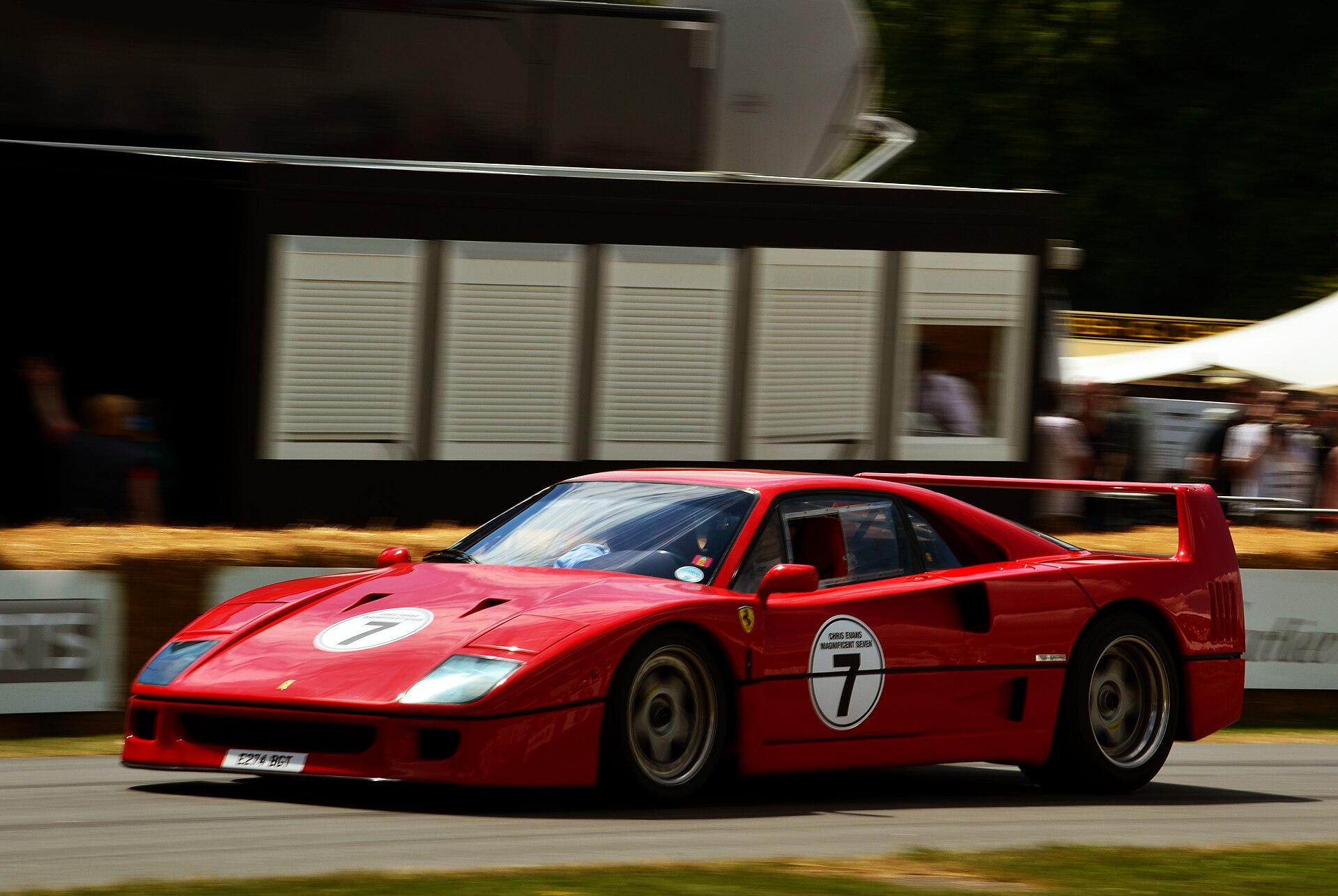
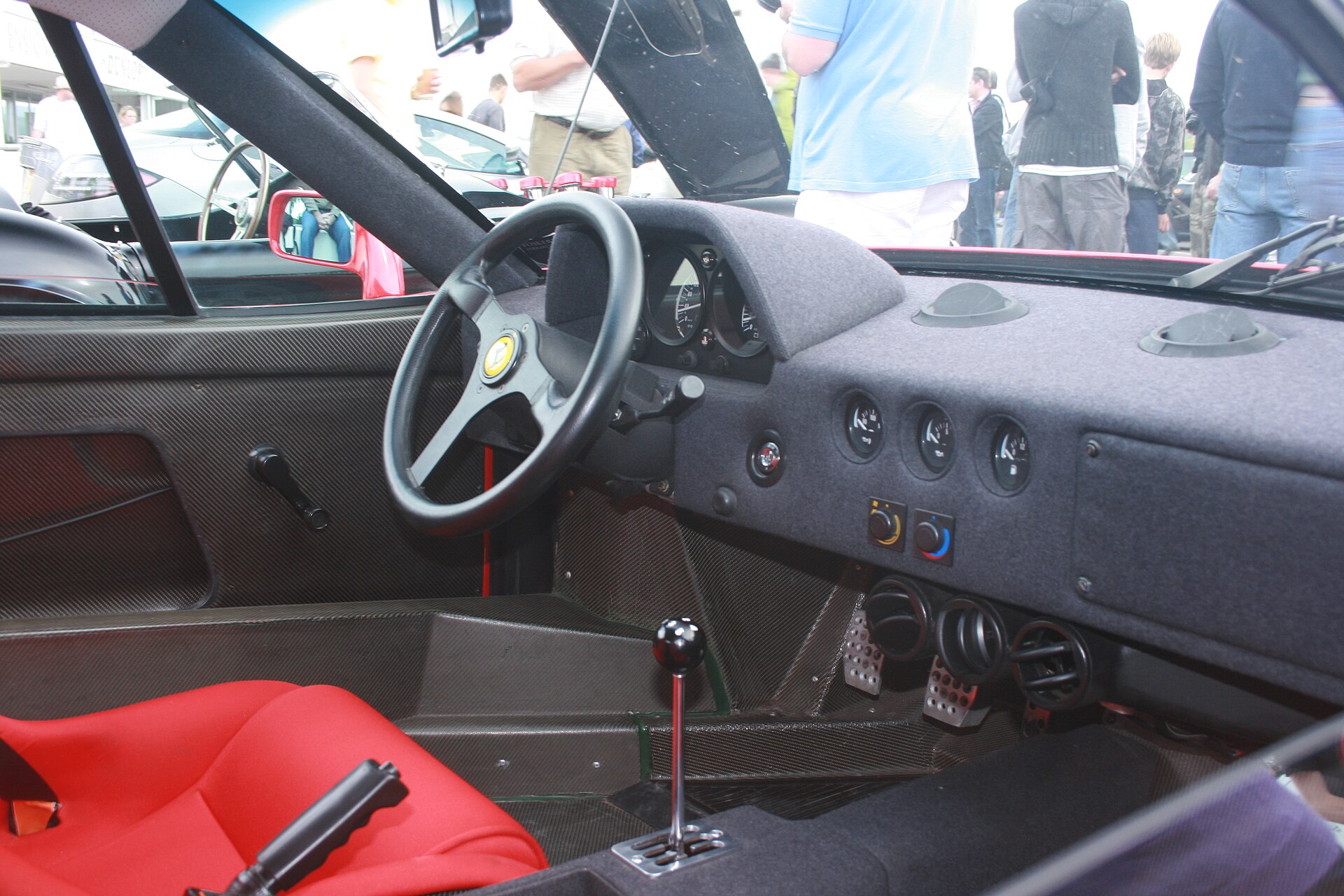
F40 GTE #41 (Ayles / Monti / Mancini) at the Ford Chicane, 1995 24 Hours of Le Mans Photo: Martin Lee from London, UK via Wikimedia Commons · License: CC BY-SA 2.0F40 GTE #40 (Olofsson / Della Noce / Oota) exiting the Esses, Le Mans 1995 Photo: Martin Lee from London, UK via Wikimedia Commons · License: CC BY-SA 2.01993 F40 LM, s/n 97893, at the Goodwood Festival of Speed 2017 Photo: Neil via Wikimedia Commons · License: CC BY 2.0Ferrari F40 at the 2014 Goodwood Festival of Speed Photo: Nic Redhead via Wikimedia Commons · License: CC BY-SA 2.0Interior: Ferrari F40 cockpit Photo: Supermac1961 via Wikimedia Commons · License: CC BY 2.0
On track
Ferrari F40 at speed · AI-rendered illustration by Idle & Rev, not real footage
Gallery
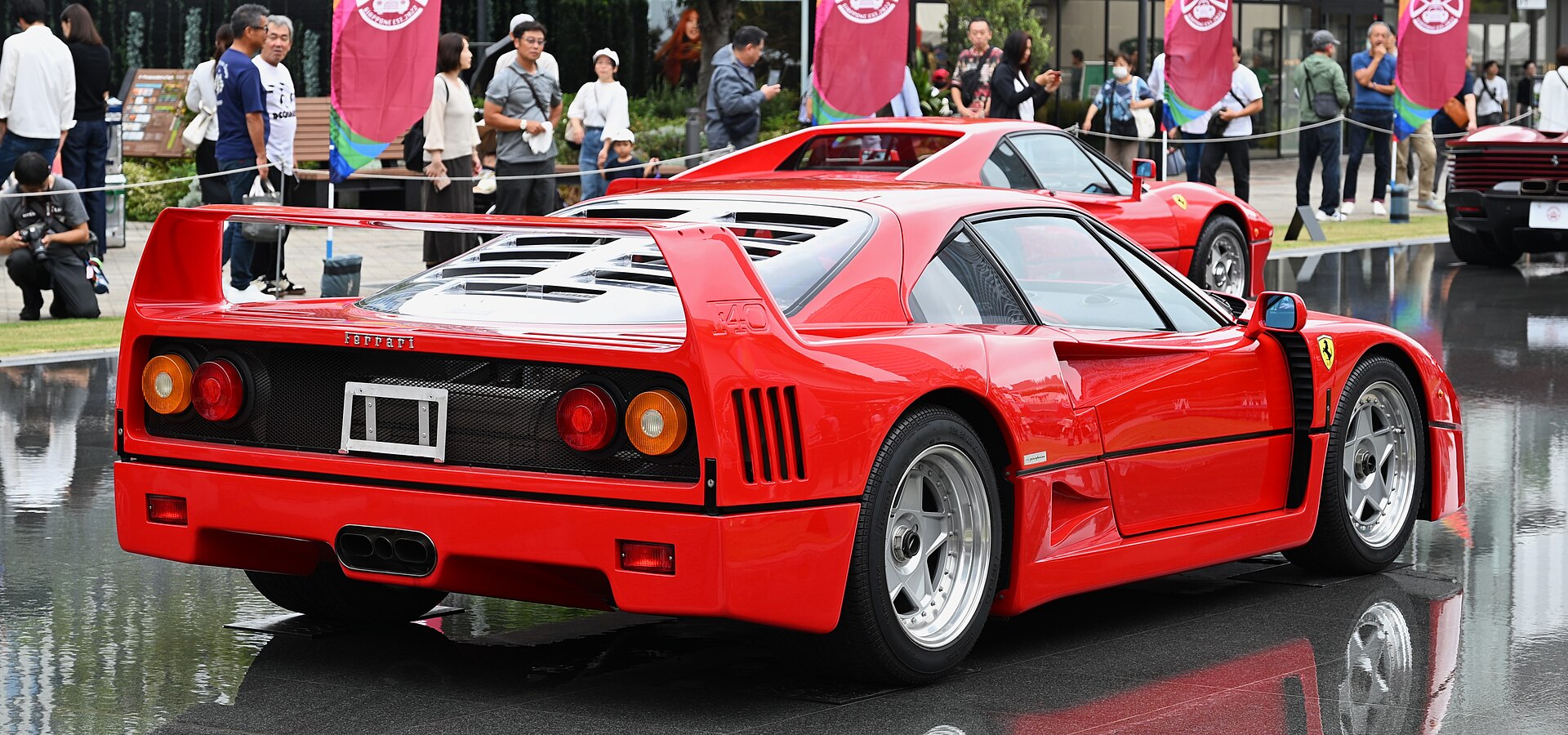
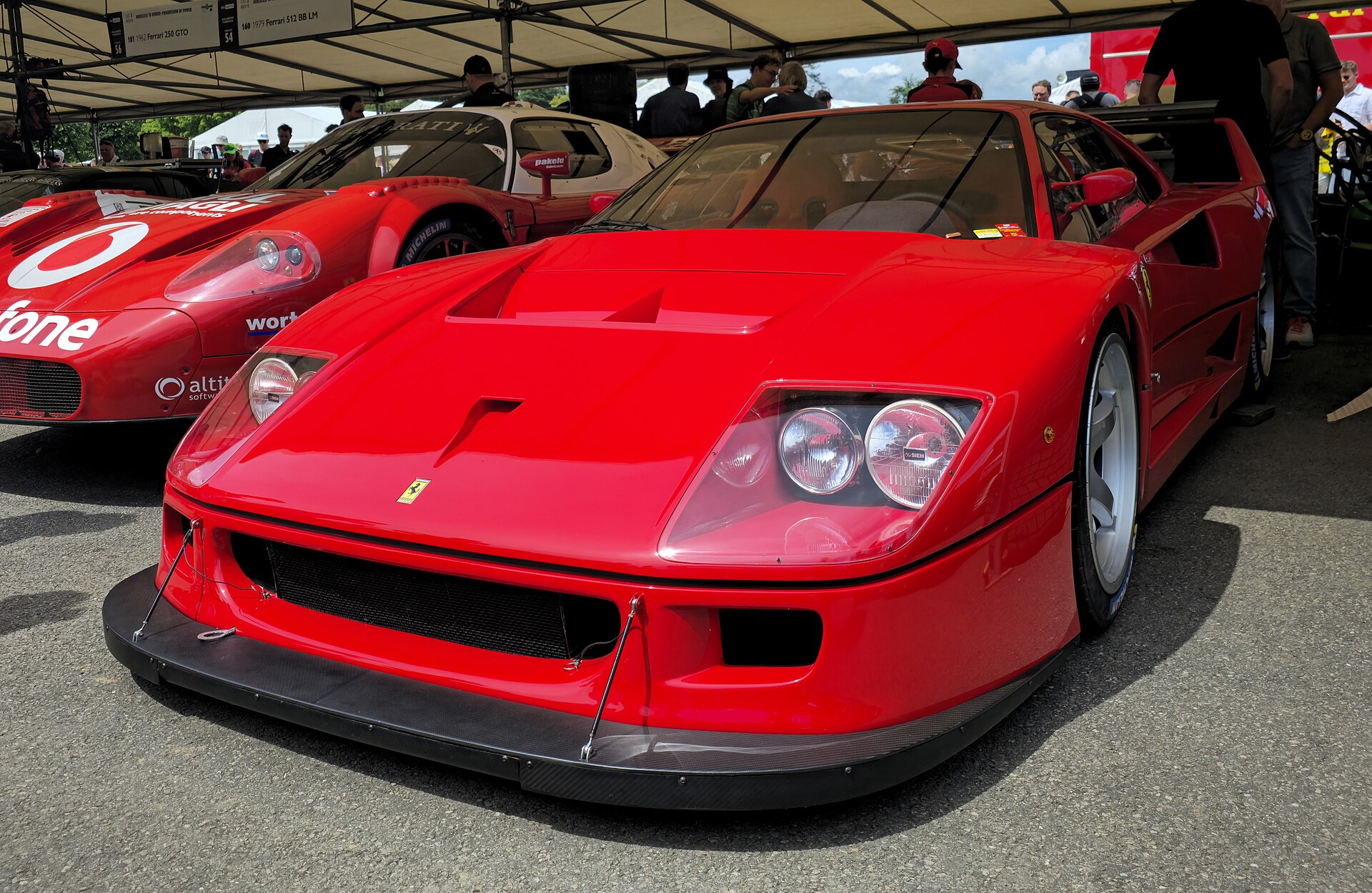
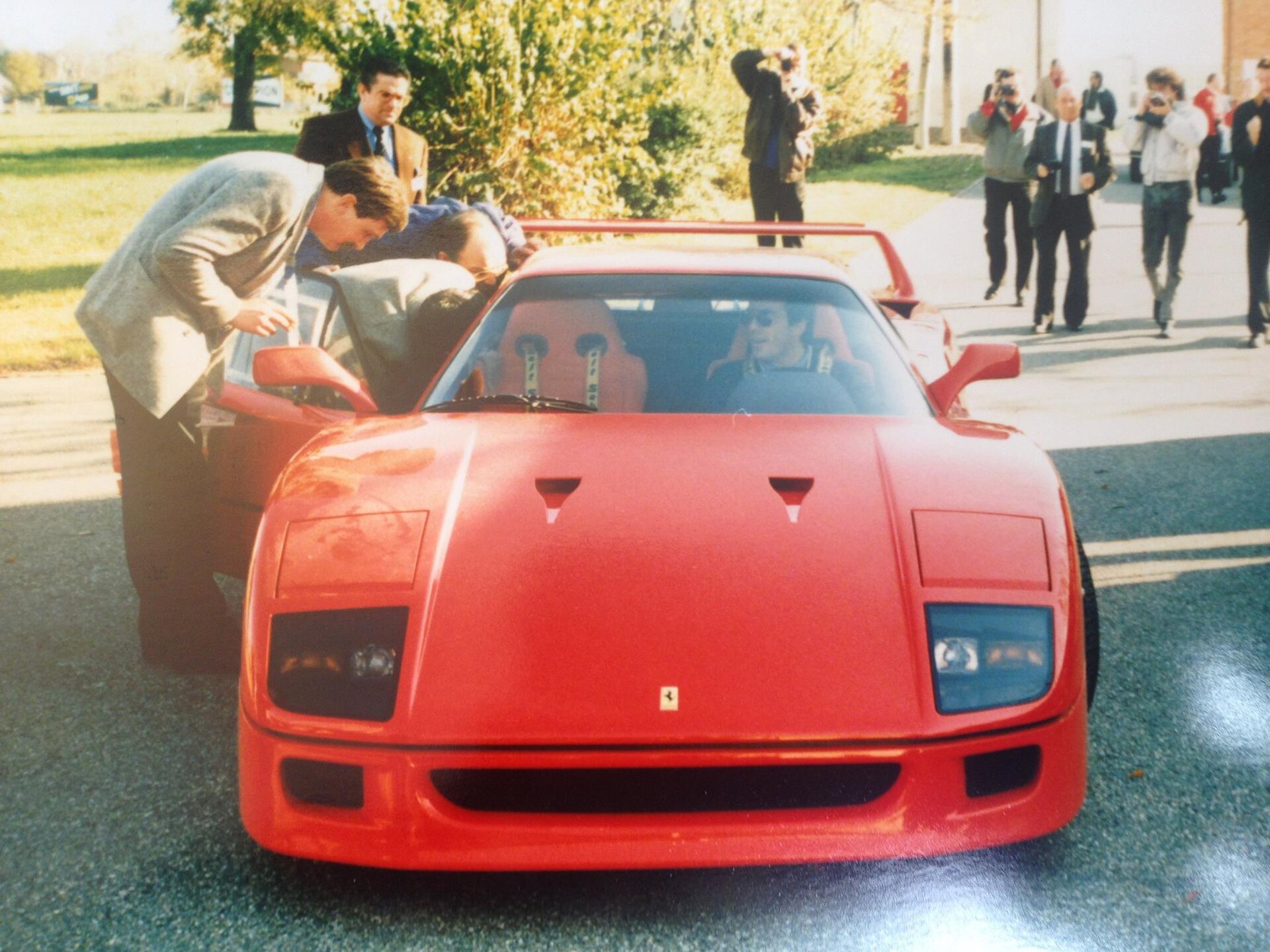
1990 Ferrari F40, rear view Photo: TTTNIS via Wikimedia Commons · License: CC01993 Ferrari F40 LM race version Photo: Calreyn88 via Wikimedia Commons · License: CC BY-SA 4.0F40 at Fiorano, Nov 15, 1987, during Ferrari's 40th-anniversary celebration Photo: Unknown photographer via Wikimedia Commons · License: Public domain